Meta2026-10-22 05:00:33Meta strikes deal with Zuckerberg on non-voting shares tied to California tax proposalMeta said it has reached an agreement with CEO Mark Zuckerberg under which the company will grant him saleable non-voting shares to cover potential tax liabilities if California’s Proposition 40 is approved next month. The proposal would impose a one-time 5% wealth tax on billionaires in the state, and Zuckerberg had previously said he was considering leaving California if it passes. In return for the share arrangement, Zuckerberg agreed to live in California or where Meta is headquartered for eight years. Meta said Zuckerberg, whose net worth is about $240 billion, would be able to immediately sell 20% of the Class C shares he receives, equal to 10% of his economic interest in the company, while keeping voting control. The company also plans to issue new non-voting Class C common stock in January 2027, with an effect equivalent to a two-for-one stock split.40
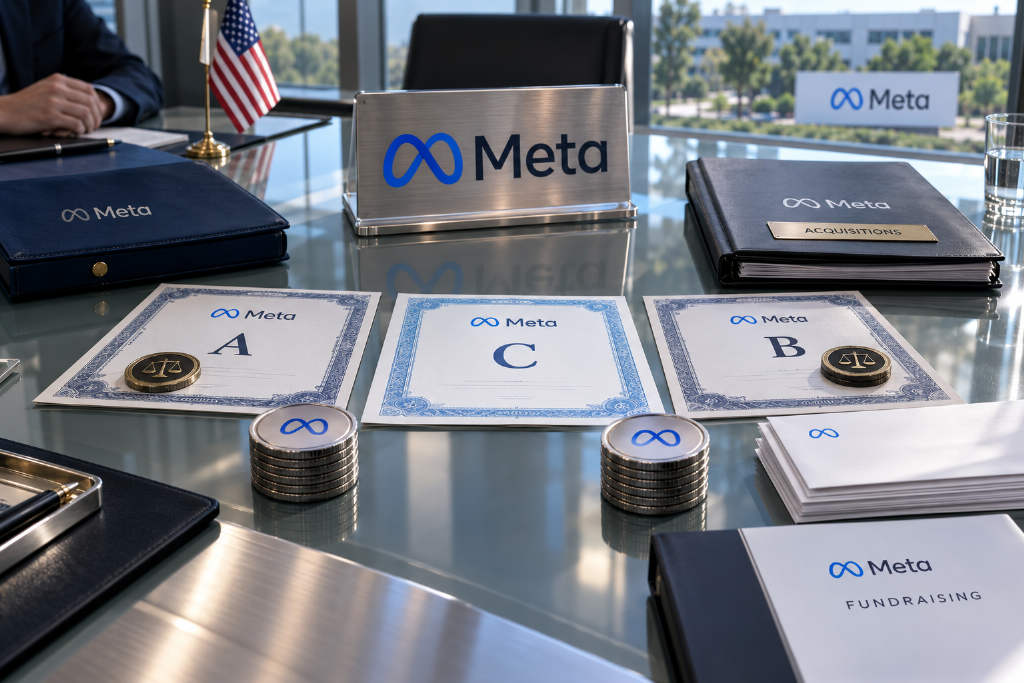
Meta2026-10-22 03:52:50Meta approves non-voting Class C shares, plans one-for-one stock dividend tied to founder controlMeta said on Oct. 21, alongside its third-quarter earnings release, that its board has approved a new class of non-voting Class C common stock, effective Jan. 19, 2027. Under the plan, each existing Class A and Class B share will receive one Class C share as a stock dividend. The company said the distribution is expected to create an effect similar to a two-for-one stock split in the market price of Class A shares, while leaving shareholder voting rights unchanged. Meta said one reason for creating the new share class is to preserve the founder-led structure that it says has supported the company since its founding, allowing founder and CEO Mark Zuckerberg to continue leading the company. According to Meta, the move followed a unanimous recommendation from a special committee of independent directors. The company said the new shares could be used for fundraising, employee compensation, potential acquisitions and other general corporate purposes, particularly as it faces large investment needs tied to AI competition, infrastructure expansion and new strategic initiatives. In the same earnings release, Meta reported third-quarter revenue of $64.601 billion, up 26% year over year, net income of $9.86 billion and earnings per share of $3.83.20
Meta2026-10-22 01:50:14Meta posts 26% revenue growth as free cash flow turns negative and board approves non-voting Class C sharesMeta paired a strong third-quarter revenue report with a capital structure move that could reshape how economic ownership and voting power are separated. The company said quarterly revenue reached $64.6 billion, up 26% year over year, while also announcing the creation of non-voting Class C shares to be distributed to existing shareholders on a proportional basis. At the same time, Meta disclosed a founder agreement covering Mark Zuckerberg’s sale of newly received shares, continued service commitments, and a residency pledge. The earnings release also showed why the board’s agenda extended beyond the income statement. Meta recorded $9.89 billion in charges tied to settlements in youth-related litigation, which weighed on reported profitability. Even after backing out that charge, operating profit growth of about 11.4% lagged revenue growth, and operating margin fell to about 35.4% from roughly 40.1% a year earlier. Cash flow was the sharper pressure point. Operating cash flow came in at nearly $32.8 billion, but equipment purchases and principal payments on finance leases totaled about $34.9 billion, pushing free cash flow into negative territory before dividends. Meta also narrowed its full-year capital expenditure outlook to $135 billion to $145 billion, raising the low end while keeping the high end unchanged.20
Meta Platform2026-10-21 22:31:47Meta signs agreement requiring Zuckerberg to remain in headquarters jurisdiction for eight yearsMeta Platforms has signed an agreement with CEO Mark Zuckerberg requiring him to continue residing in the jurisdiction where the company’s headquarters is located for the next eight years, according to ChainCatcher. The arrangement was described as a response to a proposed wealth tax in California, which could leave Zuckerberg facing a tax bill worth several billion dollars if the measure moves ahead. The agreement also allows him to sell part of his Class C shares to secure liquidity and address potential tax obligations tied to California Proposition 40. The report did not provide additional details beyond the residency requirement, the proposed tax exposure, and the share-sale provision.10